
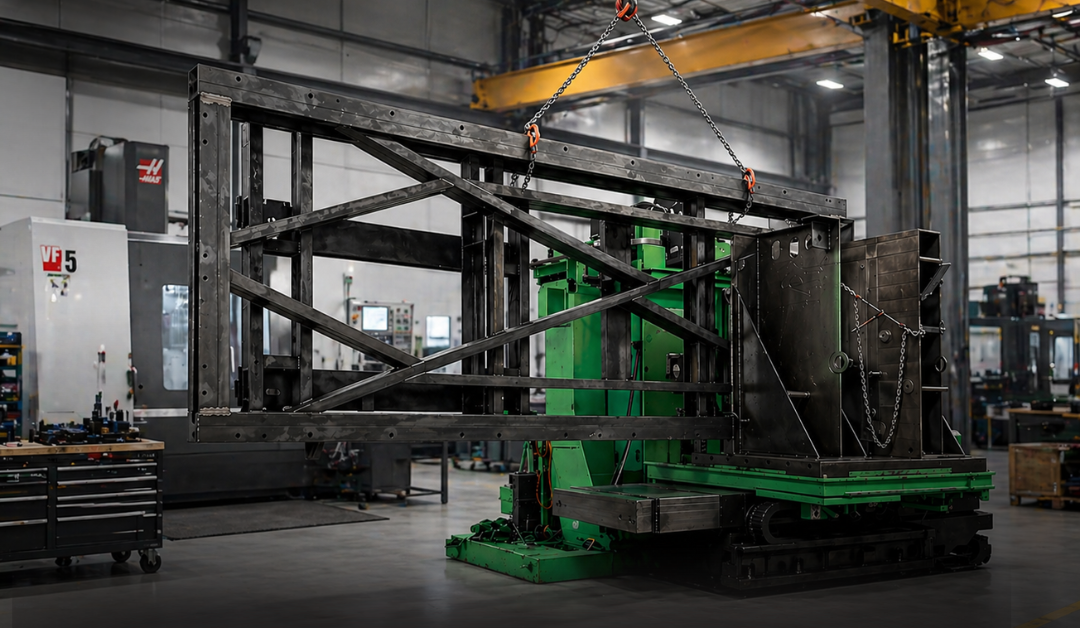
In many industrial and defense applications, fabrication is the most efficient way to build large or complex structures. Plate cutting, forming, and welding allow manufacturers to create robust components quickly and cost-effectively.
But fabrication alone is rarely enough.
At Hillside Custom Machining, we routinely see fabricated parts that must transition into precision machining before they become truly functional. The reason is simple:
Fabrication creates structure — machining creates precision.
Fabrication Builds the Form — Machining Defines the Function
Fabrication processes such as laser cutting, welding, and forming are ideal for creating the overall shape of a part. However, these processes naturally introduce variability, including:
- Heat input from welding
- Material movement and stress
- Tolerance limitations from cutting processes
Because of these factors, fabricated parts alone often cannot meet the tight tolerances required for critical applications.
That’s where precision machining becomes essential.
Where Precision Machining Matters Most
1. Sealing Faces
Sealing surfaces are among the most critical features in fabricated components, especially in fluid handling systems, pressure vessels, and naval applications.
Without machining:
- Surfaces may be uneven or warped
- Gasket compression becomes inconsistent
- Leaks and pressure loss become likely
Precision machining ensures:
- Flatness within tight tolerances
- Proper surface finishes for sealing
- Reliable, repeatable performance under pressure
2. Bores and Bearing Surfaces
Fabricated holes or torch-cut openings rarely meet the requirements needed for precision alignment or rotating components.
Without machining:
- Misalignment causes premature wear
- Bearings fail due to improper fit
- Rotating components lose efficiency
Machining corrects these issues by:
- Holding tight diameter tolerances
- Ensuring concentricity and alignment
- Providing proper surface finishes for motion and load
3. Mounting Points and Interfaces
Fabricated assemblies often include flanges, brackets, and connection points that must align precisely with mating components.
Without machining:
- Bolt holes may not line up correctly
- Assemblies require force-fit installation
- Stress is introduced into the system
Machining guarantees:
- Accurate hole locations and spacing
- Flat, square mounting surfaces
- Seamless integration into larger assemblies
Weld Distortion: The Hidden Variable
One of the biggest challenges in fabrication is weld distortion.
As welds cool, they shrink, pulling material out of position. This can result in:
- Warped plates
- Twisted frames
- Misaligned features
Even with skilled welders and proper fixturing, some level of distortion is unavoidable.
How Machining Corrects It
Precision machining restores geometry after fabrication by:
- Re-establishing datums (true reference points)
- Flattening critical surfaces
- Aligning features across the entire part
In many cases, machining is not just a finishing step — it is a corrective process that brings the part back into specification.
Real-World Tolerance Risks
When fabrication and machining are not properly integrated, problems appear quickly — and expensively.
Common Risks
Tolerance Stack-Up
Small deviations across multiple features can lead to major misalignment during final assembly.
Rework and Scrap
Parts that cannot be corrected after fabrication may need to be completely remade.
Assembly Delays
Poorly aligned components slow production schedules and increase labor costs.
Field Failures
Poor sealing, vibration, or misalignment can lead to serious performance issues in service.
The Case for an Integrated Approach
The most reliable way to avoid these issues is to treat fabrication and machining as a single, coordinated process — not as separate operations.
At Hillside Custom Machining, this means:
- Planning machining allowances during fabrication
- Establishing datums early in the process
- Sequencing operations to minimize distortion impact
- Inspecting parts at multiple stages — not just at the end
Final Thoughts
Fabrication is essential for building strong, scalable components, but it does not deliver the precision modern applications demand.
That precision comes from machining.
Whether it’s sealing faces, bores, or mounting interfaces, the transition from fabricated structure to machined accuracy is where performance is truly defined.
For engineers and buyers alike, the takeaway is clear:
If the part has to function — not just exist — precision machining is not optional. It’s critical.